A single face photo might soon tell a doctor something useful about your health. By the end of this article, you will understand what researchers built, what it claims to do, and the practical questions worth asking if a clinic ever wants to scan your face.
What the researchers built
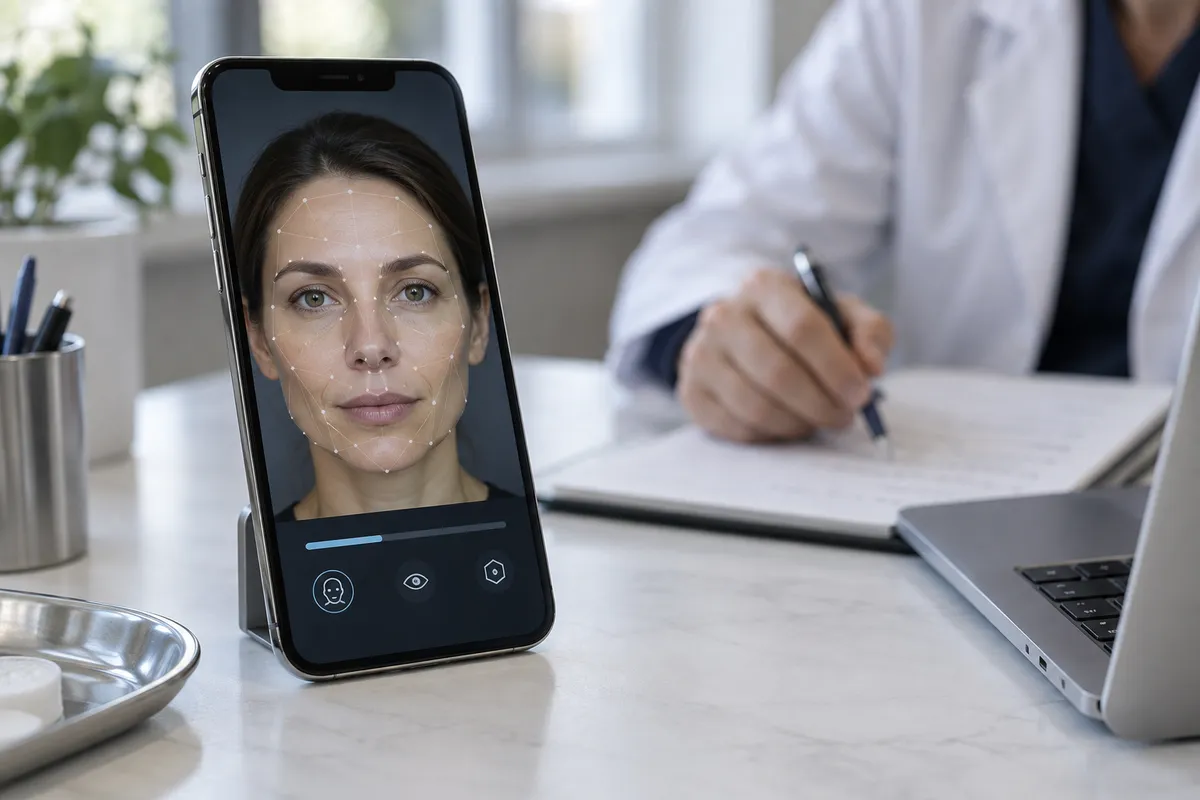
Per Medicalxpress, researchers at Mass General Brigham developed an AI tool called FAHR-Face. It is a foundation model, meaning a large AI system trained on a huge amount of data first and then applied to specific tasks. According to the report, FAHR-Face was trained on more than 40 million face images.
From one facial photograph, the tool estimates biological age and predicts cancer survival risk. The study argues that this kind of facial AI could help physicians assess frailty and personalize treatment, without replacing clinical judgment.
Biological age vs. the number on your ID
Your chronological age is how many birthdays you have had. Biological age is an estimate of how old your body seems, based on signs of wear. Two 65-year-olds can differ a lot: one may recover from illness quickly, the other may not.
Face-based AI treats the face as a visible record of that wear. The model looks at facial features in a photo and produces an age estimate that may differ from your real one. A face that reads older than its owner's years could be a signal worth a doctor's attention. That is the basic idea, and it is why researchers are interested in the face at all: it is easy to photograph and already visible.
Why doctors would want this for cancer care
Cancer treatment is increasingly personalized. Intensive treatments can help, but they also demand physical reserve. A doctor deciding what to recommend needs a sense of how well a patient can tolerate it, often described as frailty.
According to the report, clinicians need scalable ways to evaluate that reserve before recommending intensive care. A photo is quick and cheap compared with many assessments. The study's framing is that the AI result would be one more input for the physician, not a verdict.
The practical upside
If the approach holds up, the appeal is simple:
- Speed: a photo takes seconds.
- Low burden: no extra needles, scans, or appointments.
- Scale: the same tool could, in principle, be applied across many patients.
Those are my observations about why this kind of tool is attractive, not findings from the study.
Where the risks sit
Predicting survival from a face raises fair concerns. The source material points to privacy and ethics as open questions, and these are the ones I would ask about.
Privacy
A face photo is personal data. If it can reveal health information, then who stores the image matters, and so does who else can run analysis on it. Photos you share online or with a service could in theory carry more information than you intended. Whether that happens in practice is not something the report establishes.
Bias
Any model trained on faces can perform differently across groups if the training data is uneven. Even with 40 million images, a reader should want to know how well the tool works across ages, skin tones, and backgrounds. I cannot tell you those results from the reporting available, so treat it as a question to ask rather than a finding.
Influence on decisions
A survival prediction can shape what treatment someone is offered. The study stresses that the tool should support clinical judgment, not replace it. That distinction matters most when the number looks authoritative.
What to do if a clinic offers a face scan
You do not need to be a technical person to ask good questions. If a provider ever proposes AI analysis of your photo, try these:
- Ask what it will be used for. Is it informing a treatment choice, or just research?
- Ask where the photo goes. Find out whether it is stored, for how long, and who can access it.
- Ask if you can decline. Opting out should not affect your basic care.
- Ask how the result will be used alongside other tests. A reasonable answer is that it is one input among many.
- Ask for the result in plain language. You are entitled to understand what it says about you.
A note on everyday photos
Nothing in the reporting suggests your phone's camera roll is being used this way. Still, it is a good moment to review which apps can see your photos and which services store your selfies. On most phones, you can find this in the privacy or permissions section of Settings. Check it against your current OS version, since menu names vary.
The takeaway
FAHR-Face shows that a face photo can be turned into a health signal, at least in a research setting. Before any tool like it touches your care, ask what it is for, where your image goes, and who makes the final call. Make sure the answer to that last one is your doctor, with you in the conversation.