
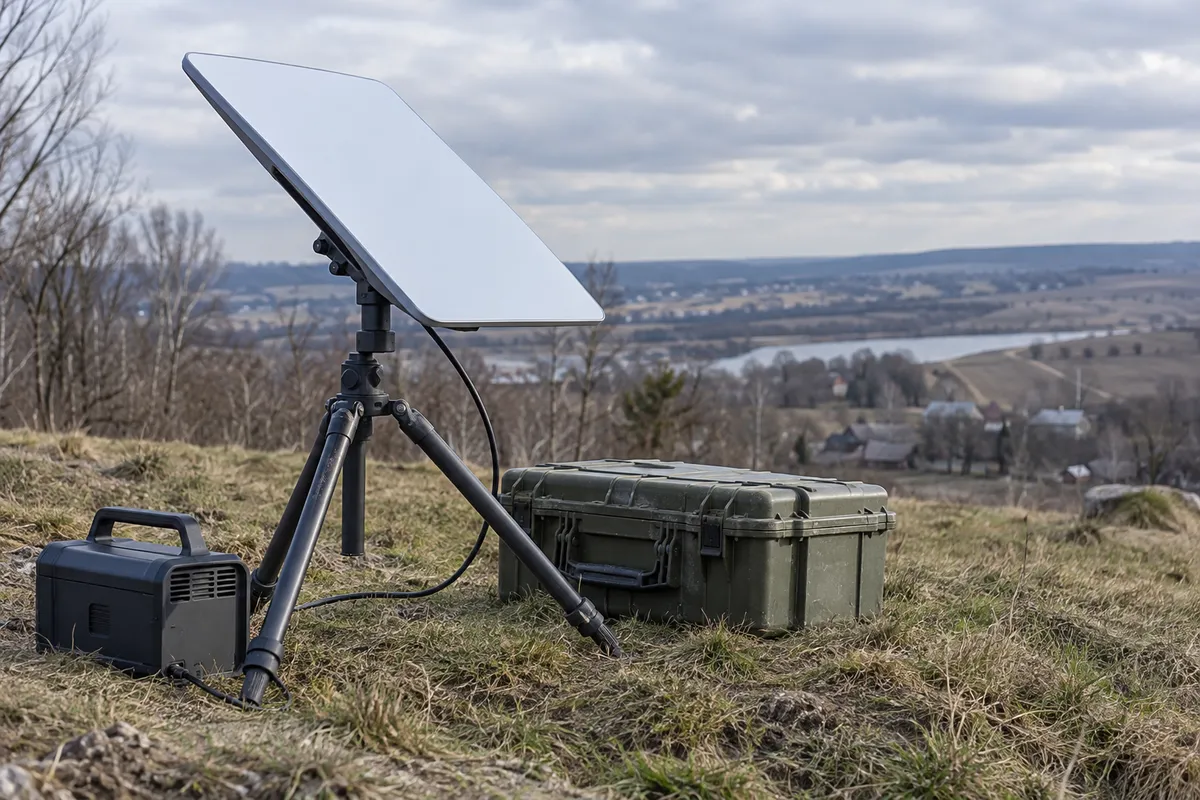
If you have ever lost your home internet during something important, you know how much rides on a connection you don't control. Ukraine is facing that problem at national scale. Understanding why tells you a lot about how satellite internet works, what makes it hard to copy, and what to check before you rely on any single network yourself.
This piece draws on reporting from the BBC, which examined why Ukraine is so reliant on SpaceX's Starlink and whether Europe can fill the gap. Its short answer: Europe has alternatives in development, but none can yet match Starlink's speed, scale, portability, or military usefulness.
What happened
Per the BBC, a recent Starlink slowdown exposed how vulnerable Ukraine is when a critical military capability is controlled by outside political and commercial actors. The reporting describes Ukraine's deep dependence on SpaceX's Starlink and its defense-oriented sibling, Starshield, for battlefield communications, drone warfare, and defense operations.
The BBC's description of the situation is that Ukraine needs another satellite internet service, but a decent alternative to Elon Musk's network doesn't exist yet.
Why satellite internet matters so much here
The underlying logic is one any home user can grasp. Normal internet depends on cables, towers, and local infrastructure. When those are damaged or absent, you need another path. Satellite service provides one that doesn't depend on what is standing on the ground nearby.
The BBC's reporting points to four qualities that make Starlink hard to replace:
- Speed: Fast enough for demanding uses, not just basic messaging.
- Scale: Capable of serving a large number of users at once.
- Portability: Equipment that can be moved and set up where it is needed.
- Military usefulness: Suited to defense operations, including drone warfare.
An alternative has to deliver all four together. Per the BBC, none of the European options in development can do that yet.
Europe's options
The BBC reports that Europe has alternatives in development as it reassesses its defense autonomy. Satellite connectivity, in the report's framing, has become a frontline security issue. A European project such as Iris² is part of that push toward space-based independence, though the reporting is clear that nothing available today is a full substitute.
It's worth separating two ideas here. Having a plan is not the same as having working service. Until a network is flying, tested, and deployable at scale, it can't take over from one that already is.
The risk of one provider
The BBC's central concern is control. When a vital capability sits with a private company and its owner, the people who depend on it don't set the terms. A slowdown, a policy change, or a business decision can ripple outward.
This is our analysis rather than the BBC's, but the lesson scales down neatly. Most of us have a single point of failure somewhere: one home internet provider, one cloud account, one phone carrier.
What you can borrow from this at home
You are not running a military network, but the same thinking applies to your own setup. A few practical steps:
- Identify your single points of failure. List what you'd lose if your home internet went down: work, smart home devices, security cameras, banking.
- Set up a backup connection. Your smartphone's hotspot is the simplest option. On an iPhone, go to Settings > Personal Hotspot. On most Android phones, go to Settings > Network & internet > Hotspot & tethering. Check your plan's hotspot data allowance first.
- Test the backup before you need it. Connect a laptop to the hotspot now and confirm it works for video calls.
- Keep key files available offline. Store important documents on your device or an external drive, not only in the cloud.
- Know your provider's outage page. Bookmark it on your phone so you can check status over mobile data.
What to watch next
Per the BBC, the open question is whether Europe can build sovereign space infrastructure before the next crisis. The reporting doesn't give a timeline for when an alternative could match Starlink, so treat any confident date with caution.
The takeaway: don't wait for an outage to find out what you depend on. Spend ten minutes this week setting up and testing a backup connection.