President Donald Trump proposed a $5,000 dividend for adult U.S. citizens if Republicans hold the House and Senate majority, and warned of a 1929-style economic depression if Democrats win, per Fox News. Claims like this spread fast on social media, and they tend to arrive stripped of context, sometimes with a scam attached.
This guide won't weigh in on the politics. It gives you a repeatable way to check any big money promise on your phone or computer in about five minutes, and to avoid the fake offers that pile up around headlines like this one.
What the reporting actually says
Start by separating what is known from what is not. Per Fox News, the proposal is a $5,000 dividend for adult U.S. citizens, conditional on Republicans keeping control of both chambers. The same report says Trump warned of an economic depression comparable to 1929 if Democrats win.
That is the extent of what we can state here. The reporting we have does not detail how the payment would be funded, how it would be distributed, or what legislation would be needed. Those gaps matter. A proposal made on the campaign trail is not a law, and nobody can currently claim you are owed a payment.
Step 1: Find the original source
Before you share or react to a screenshot or clip, trace it back.
- Search the exact claim in your browser (Chrome, Safari, Edge, or Firefox, any current version) along with a major outlet's name, such as "voter dividend $5,000 Fox News."
- Check the date. Old stories get recirculated as new. Look for the publication date at the top of the article.
- Open the link, not the screenshot. On iPhone or Android, press and hold a link to preview the web address before opening it.
- Look for the speaker's own words in a full transcript or video rather than a clipped summary.
If you can't find the claim in at least one established outlet, treat it as unverified.
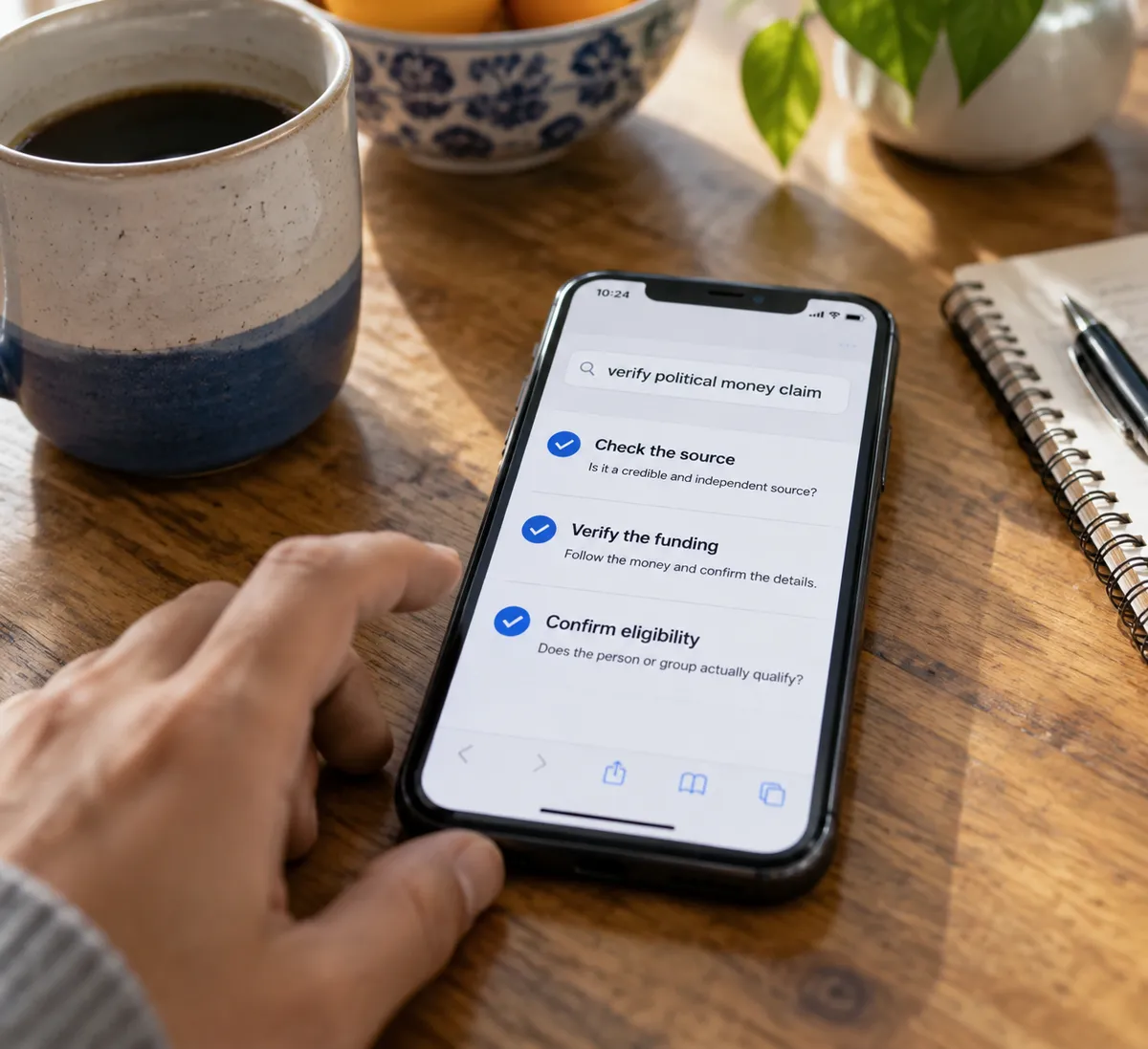
Step 2: Ask the three feasibility questions
Any large payment promise can be tested with the same questions. You don't need an economics degree.
Who qualifies?
The reporting says adult U.S. citizens. Notice what that leaves open: income limits, registration requirements, and whether you must have voted. Vague eligibility is a sign a plan is still a talking point.
Who pays and how much?
Do a quick back-of-envelope check on your phone calculator. Multiply $5,000 by the number of adult citizens you think there are. The result is enormous, which is exactly why you should look for a stated funding source. We don't have one in the reporting, so be cautious about anyone who claims to know the cost or the funding method.
What has to happen first?
Spending of this kind typically requires Congress to act. A promise tied to an election outcome is a conditional pledge, not a scheduled payment.
Step 3: Treat fear framing as a flag
The 1929 comparison is a strong emotional message. When a claim pairs a reward with a threat, slow down. Ask whether the evidence for the threat is presented or only asserted. You can search for historical background on the 1929 crash from a library, university, or government archive site and judge for yourself whether the comparison fits. Both sides of any campaign use this pairing, so the habit applies no matter who is speaking.
Step 4: Protect yourself from copycat scams
Headlines about government payments reliably attract fraud. Expect texts, emails, and social posts offering to "claim your dividend." Here is how to shut them down.
- Never pay a fee to receive a government payment. Real programs don't ask for gift cards, crypto, or upfront charges.
- Don't tap links in unsolicited texts. On iPhone, use Settings > Messages > Filter Unknown Senders. On Android's Google Messages, open Settings > Spam protection and turn on enhanced protection.
- Report and delete. Forward suspicious texts to 7726 (SPAM), which most major U.S. carriers support, then delete them.
- Skip "verify your identity" forms asking for your Social Security number or bank login in response to a news item.
- Go directly to official sites by typing the address yourself. Government sites in the U.S. end in .gov.
Because there is no enacted payment in the reporting, any message saying you can sign up for one right now deserves extra suspicion.
Step 5: Set up a quick verification routine
Make this automatic so you aren't deciding under pressure.
- Pause before sharing anything with a dollar figure in it.
- Search the claim plus "fact check."
- Read at least two outlets with different editorial leanings.
- Note what is a proposal, what is a prediction, and what is confirmed.
- If an offer asks for your information, close it and go to the official site.
Saving a bookmark folder of two or three fact-checking and news sites on your phone's browser makes this faster next time.
The takeaway
When a headline promises money or predicts disaster, find the original report, separate the proposal from the plan, and never give personal information to anyone claiming you can collect early.